
This 2-hour course, presented by Candace Heisler, J.D., PS SME and former criminal prosecutor, provides practical guidance for navigating and collaborating with the criminal justice system during investigations and ongoing services. The session introduces the structure and roles of key partners, including local and state law enforcement, district attorneys, courts, probation, parole, and corrections, and explains how these systems intersect with PS responsibilities.
Participants will learn when and how to make effective reports to law enforcement, what information can be shared, how to coordinate around safety concerns, and how criminal proceedings may affect an older adult's risk, autonomy, and service options. The course emphasizes person-directed, trauma-informed communication with both criminal justice partners and older adults who may feel intimidated or traumatized by legal processes. Through applied examples, scenarios, and documentation guidance, learners gain practical tools for making collaborative decisions, supporting older adults involved in the justice system, and ensuring their work remains defensible, respectful, and aligned with core standards.
This comprehensive six session training program is designed for new Protective Services (PS) staff in a variety of roles and combines online and in-person classroom instruction. Please review the schedule for the dates, times, and location of each session, as training will take place in both virtual and classroom settings. Participants will gain a thorough understanding of the responsibilities and duties of a Protective Services worker, covering every stage of the case process from Intake through Case Closure. Interactive, skill-based sessions provide opportunities to practice the essential knowledge and skills needed to become a successful Protective Services professional.
Training will cover:
- Investigation: Steps and methods for conducting thorough investigations.
- Interviewing Skills: Techniques and best practices for conducting effective, empathetic, and person-centered interviews.
- Documentation: Practice professional documentation skills throughout every phase of a case while developing an understanding of Massachusetts regulations governing casework documentation.
- Risk Assessment: Identifying and evaluating risk factors to help ensure client safety.
- Service Planning and Ongoing Services: Developing and implementing effective service plans while providing ongoing client support.
- Reassessment and Case Closure: Procedures for reassessing cases and completing the case closure process.
Please note: Training registration requirements and additional details are provided within each training section. For questions or additional assistance, please contact Connie Boris, PS Training Coordinator at Constance.Boris4@mass.gov.
Interview for Decisional Abilities (IDA) is an interactive live virtual training to learn to assess your clients abilities to make certain decisions. The training is a two day training with approximately one month in between Day 1 and Day 2.
Day 1 will contain an overview of what IDA is, viewing IDA role-plays and each participant will role- play in order to practice the technique and receive feedback before using it in the field.
Between Day 1 and Day 2 you must conduct IDAs with your clients and provide the written document that goes along with IDA for review and feedback.
Day 2 consists of more interactive live role-play from all participants and a change to discuss what went well or not so well in the field and get feedback on what may help in a similar situation.
Each day of the training is 3 hours, 9:30-12:30. When you sign up you will be agreeing to attend both scheduled days.
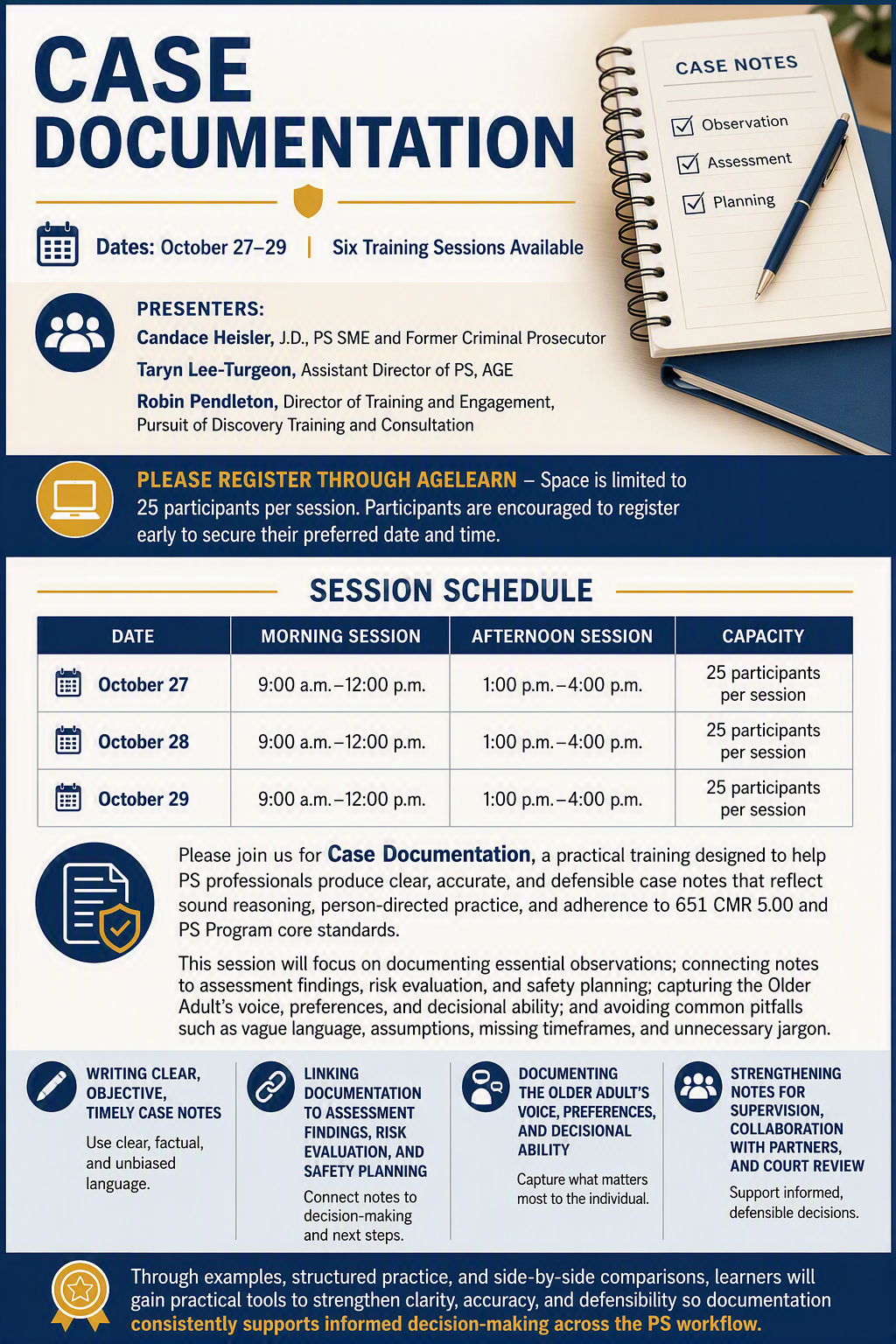
Please join us in-person for Case Documentation, a practical training designed to help PS professionals produce clear, accurate, and defensible case notes that reflect sound reasoning, person-directed practice, and adherence to 651 CMR 5.00 and PS Program core standards.
This session will focus on documenting essential observations; connecting notes to assessment findings, risk evaluation, and safety planning; capturing the Older Adult’s voice, preferences, and decisional ability; and avoiding common pitfalls such as vague language, assumptions, missing timeframes, and unnecessary jargon.
Through examples, structured practice, and side-by-side comparisons, learners will gain practical tools to strengthen clarity, accuracy, and defensibility so documentation consistently supports informed decision-making across the PS workflow.